Tuesday, August 26, 2025
Drug and Alcohol Testing in the Australian Rail Industry – A Case Study
ONRSR has been studying emerging trends in drug and alcohol use in a bid to understand how they are reflected in the rail industry and discuss what can be done to ensure testing regimes remain as effective as possible in identifying and managing the risk.

At a glance
August 2025
Under Australia’s Rail Safety National Law, one of ONRSR’s key legislative functions is “to work with rail transport operators, rail safety workers, and others involved in railway operations, to improve safety nationally”.
It’s a responsibility the national regulator takes seriously and is reflected in the most recent iteration of ONRSR’s Strategic Directions which documents the requirement to Influence Safety Practices and Build Knowledge Among Rail Transport Operators.
It is in this context that ONRSR has been studying emerging trends in drug and alcohol use across Australia in a bid to understand how they are reflected in the rail industry and discuss what can be done to ensure testing regimes remain as effective as possible in identifying and managing the risk.
Background
It is an offence under Rail Safety National Law for rail safety workers to carry out or attempt to carry out rail safety work while there is any presence of alcohol or a prescribed drug in their system or while under the influence of alcohol or drugs. To reduce the risk to workers and the general public, rail transport operators are required to prepare and implement a Drug and Alcohol Management Program (DAMP), which facilitates drug and alcohol testing of their rail safety workers. Rail transport operators report drug and alcohol testing results to ONRSR every month. This data includes the numbers of tests undertaken and positive tests recorded.
What does the data tell us?
An initial analysis of industry testing data for the period between 2018 and 2023, shows the alcohol positive rate has stayed fairly consistent at less than .01% of all tests conducted. However, the rate of positive drug tests (cannabis (THC), methamphetamine/ ‘speed’ or MDMA/ ‘ecstasy’) recorded, while still below 1%, has effectively doubled over the same period of time.
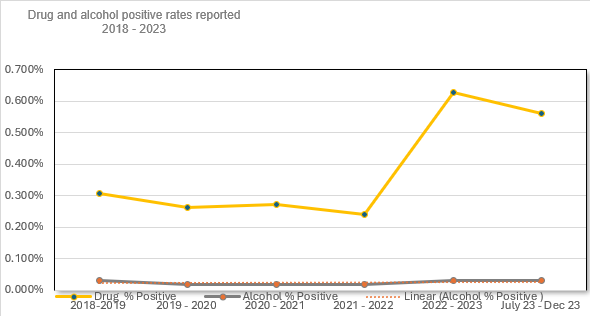
While compelling, in isolation rail operator monthly return data sets don’t provide a contextualised assessment of the issue, nor do they provide a broader societal view with which to compare trends in the rail industry.
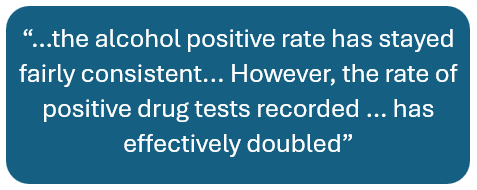
To provide such an insight, ONRSR has sourced data from the National Drug Strategy Household Survey 2022-2023 (NDSHS) – the leading survey of legal and illicit drug use in Australia. More than 21,000 people across the country took part in the latest survey which essentially looks at what has changed over the past 20 years. Among its key findings was a clear conclusion that “in Australian society the use of drugs is on an upward trend while risky alcohol consumption is on the decrease.” As the infographic (below) demonstrates, the survey looked at both recent and lifetime drug use, noting both were increasing despite the significant reduction in risky alcohol consumption.
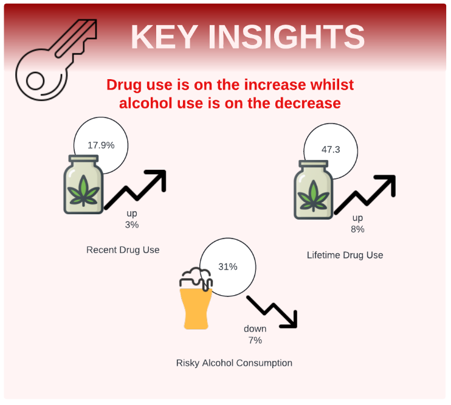
The survey also provided invaluable data in relation to changing trends in the type of drugs Australians are using. While cannabis use remains fairly stable and is still the most used drug in this country, there has been a significant increase in the use of cocaine and hallucinogenic drugs (LSD/Acid/Tabs or Mushrooms/Psilocybin). Over the same 20-year period, the use of ecstasy has declined while contrary to public perception, the use of methamphetamine is currently comparatively low.
As for who is taking these drugs, Australians in the highest socioeconomic area are the biggest users, but it is generally accepted that an issue exists across all groups in society.
What does it mean for the Australian rail industry?
Its relatively low positive rates indicate that the rail industry has done well to cultivate a culture of safety that counters the prevailing societal norms. But, given the shift in drug use in wider society and the potential for workers to transition into the rail sector, it is important to act in order to counteract this trend and continue to improve safety.
ONRSR is encouraging all rail transport operators to undertake a thorough review of their drug and alcohol testing data, analysing where possible for trends, in particular which roles may have higher percentages of positive tests. Through our own monthly return data, ONRSR categorises worker types into 7 groups - train driver, guard, controller/signaller, station staff, rolling stock maintenance staff, railway infrastructure maintenance staff and shunter.
Between August 2022 and March 2025, positive test rates were highest for railway infrastructure maintenance staff.
More holistically, operators should conduct similarly vigilant reviews of their Drug and Alcohol Management Plans to ensure they, and the testing regimes that underpin them, reflect modern research and usage trends – in particular the move toward greater use of illicit drugs and a reduction in risky alcohol consumption.
It should be noted that alcohol testing is significantly cheaper and more accessible than drug testing. Subsequently, on average, the rail industry conducts 20.5 alcohol tests for every drug test performed, even though the drug detection rate is 22.4 times higher than alcohol.
For example, according to ONRSR monthly return data from April 2023 to April 2024, there were 315 alcohol detections (out of 1,250,956 tests) and 298 drug detections (out of 56,315 tests). If the same number of drug tests were conducted as there were alcohol tests it is estimated that 6,620 drug detections would have been made.
What does it mean for ONRSR?
In addition to sharing more insights like those discussed in this case study, for its part ONRSR is in the process of changing its testing approach to adopt a more strategic, evidence-led method that complements the testing programs run by industry. The ONRSR program will take various data sources into consideration to target testing efforts in areas where they are most effective.
ONRSR is also providing additional guidance material for operators to assist them in optimising their DAMPs. This includes the release of new Drug and Alcohol Data Dashboards that provide the information in a more accessible format to facilitate deeper analysis and interrogation of testing results. These dashboards are live now on our website.
ONRSR will also provide information on trends in data and alcohol use in the rail industry to state and territory governments to ensure that the regulatory requirements continue to be fit for purpose.