Wednesday, August 26, 2026
Human Factors – An ONRSR Case Study
Human Factors: A scientific discipline concerned with the understanding of interactions among humans and other elements of a system.
The profession that applies theory, principles, data, and methods to design, to optimise human well-being and overall system performance.

At a glance
As the adoption of technology in the rail industry accelerates, effectively designing and managing how people interact with the technical aspects of the rail system is even more critical. Integrating human factors into rail operations reduces safety incidents, increases productivity and lowers staff turnover.
ONRSR is increasingly using human factors in its work with operators to optimise safe and sustainable safety systems and as a result, the regulator’s small but long-established team of ‘HF’ experts is playing a greater role than ever before.
Key Statistic
Throughout 2024-25 ONRSR invested more than 5,000 hours of professional development training across all business divisions and teams.
Background
When ONRSR opened its doors in January 2013 it did so as a collection of regulatory professionals brought together from across the length and breadth of Australia. This brand-new team comprised many and varied skill sets and unique approaches that, while invaluable to the fledgling organisation, reflected their distinctly state-based methodologies for rail safety regulation.
Undoubtedly there was strength in the collaboration that followed, allowing ONRSR to establish itself and begin to achieve the outcomes desired of the national reform agenda. However, as the calls for national consistency have grown stronger and with the next generation of reforms beckoning following the 2024 review of Rail Safety National Law, ONRSR recognises its need to evolve the way it operates supported by a contemporary training and development program delivering a truly holistic regulatory approach.
ONRSR's Rail Safety Regulation Model
ONRSR has been focused on achieving the right balance to its regulatory activities, specifically looking at how it could use all resources and expertise at its disposal to position itself as a recognised leader and collaborator for rail safety improvement.
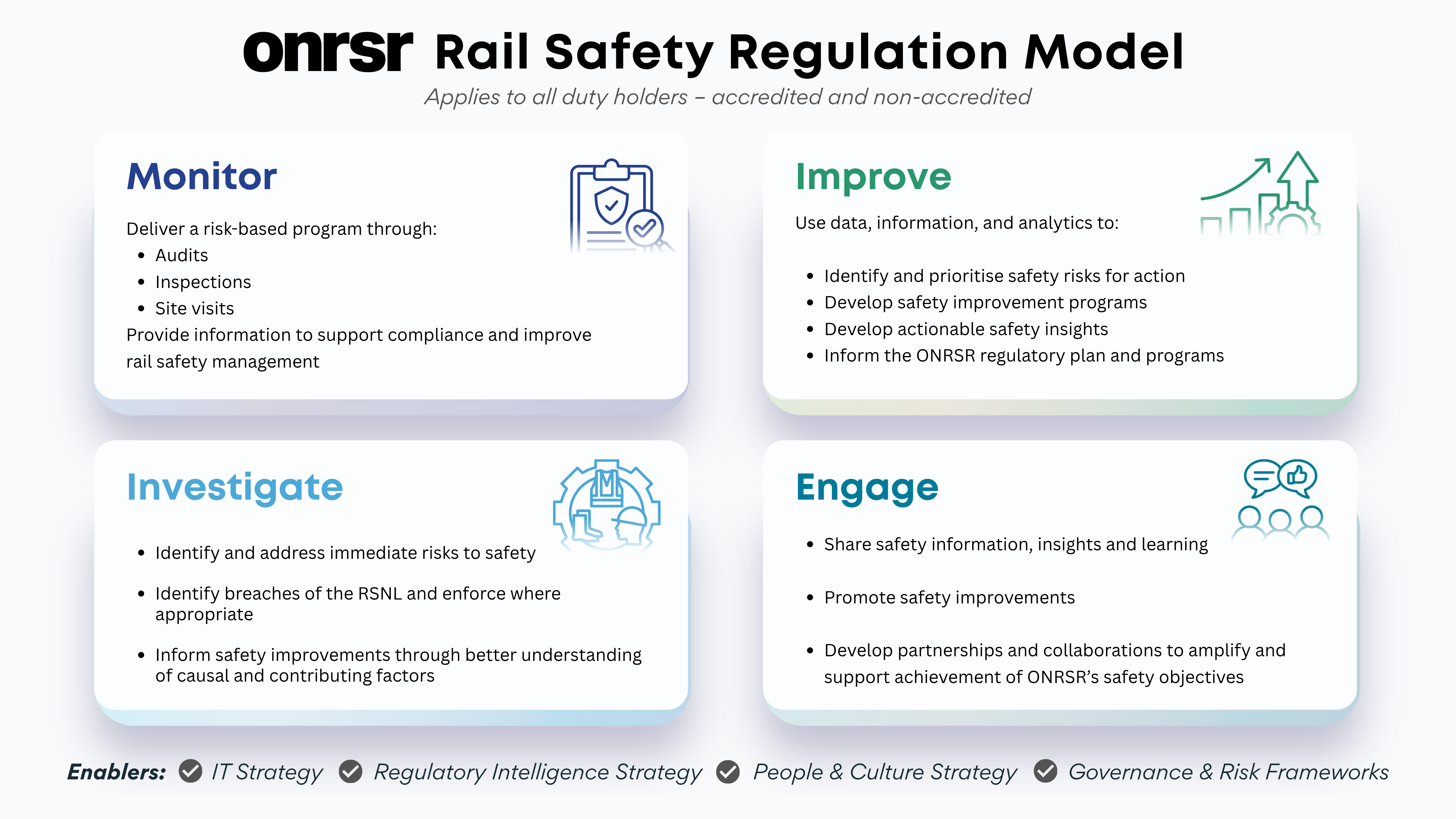
In early 2026 this work culminated in the development of a new Rail Safety Regulation Model or the ‘quadrant model’ as it has also been referred to.
In acknowledging the two schemes administered by ONRSR under Rail Safety National Law, the new model identifies the four key drivers – Compliance, Investigation, Safety Improvement, and Engagement and Education.
Together they inform a truly national ONRSR work program that comprises:
- A risk-based and intelligence led series of compliance activities such as audits, inspections and site visits designed to help monitor and secure compliance with the law through comprehensive risk management.
- Similarly, intelligence and data-driven safety knowledge builders targeting identified safety risks and problems and how to manage them –with the ability to provide actionable safety insights
- Rail safety investigations that help to understand causal and contributing factors that influence safety performance and to identify breaches of the law for enforcement action, when necessary.
- And finally, an increasing range of engagement and education activities and products to share and inform duty holders so that they can better manage risks to safety. These are delivered by working collaboratively with broader rail safety stakeholders and partners on national reforms and safety initiatives.
The model is supported by a series of enablers ensuring an all-inclusive approach and line of sight for the contribution of everyone at ONRSR in the delivery of rail safety regulation.
Supporting our People to Deliver
While the model is sustained by carefully honed information technology, data and governance strategies, an absolute fundamental to its success is the support ONRSR provides its multidisciplinary team to carry out their roles and responsibilities.
Overseen by ONRSR’s People and Capability team, work is now underway on a comprehensive Capability Framework, a structured guide that will ultimately define the essential skills, and knowledge required for employees to perform most effectively. It will cover a wide range of areas like leadership, strategic alignment, relationship management, delivering results, and will be embedded as a standardised tool for talent management across the employee lifecycle.
In the meantime, ONRSR has invested significantly in a wide-ranging learning and development program aligned to its Strategic Direction to ensure our people are valued, skilled and engaged. Recognising that leadership plays a significant role in the continued development of our team members, programs such as the 2026 ONRSR Leadership Excellence Program further uplifts the skill sets of Executive management, senior managers and a range of organisational leaders to continually build a trusting, supportive and inclusive work environment. This is further supported by a robust Learning and Development calendar of programs that builds capability of all team members across a variety of technical and enterprise skills.
Through tailored training dashboards, staff can complete onboarding and refresher training, peruse their own tailored course catalogue, delve into learner’s and trainer’s toolboxes and access a library of additional courses and resources where they can develop and review training and learning materials.
ONRSR’s purposeful learning environment is aligned to the 70 (on-the-job learning): 20 (informal learning):10 (formal learning) model where learning is a collaborative process. Encompassing a wide variety of activities, ONRSR team members have the opportunity to develop skills through on-the-job training, coaching and mentoring, stretch goals, research, internal and external courses and workshops, professional development, conference attendance, independent or supported external study/qualifications.
All of this is underpinned by the organisation’s Culture Blueprint - a means of translating organisational values into actionable behaviours and expectations for everyone at ONRSR by providing clarity on how we expect to see our values demonstrated every day.
People Focus In Practice – ONRSR Regulatory Officer Training Program (ROTP)
The ROTP is designed to equip newly appointed regulatory officers with the foundational knowledge and essential skills needed to succeed in their regulatory role. Whether they’re new to ONRSR or expanding their expertise, the ROTP provides a structured learning and development program that ensures they gain the confidence and capability to perform effectively.
The blended learning program is designed to be process and function-specific, aligning with the key functions and powers of ONRSR. Using a four-phased approach encompassing an introduction to ONRSR systems and tools, regulatory oversight, (monitoring and administration), enforcement principles and practical experience, participants progress through the 52-week program step by step, supported by essential resources, structured learning modules, and hands-on experience in the field.
ONRSR has recently included a second step in the process – the Regulatory Officer Competency Maintenance Program (ROCMP) which is a competency refresher program run every six months and designed to ensure all regulatory officers remain current in their workplace practice so that they regulate ‘the ONRSR Way’.
Final Thoughts
ONRSR Chief Executive and National Rail Safety Regulator, Dr Natalie Pelham believes the development of the Rail Safety Regulation Model is a critical step in ensuring ONRSR can drive safety improvement in the rail sector by being an adaptable, risk-based regulator with a steadfast commitment to integrity, transparency, and accountability.
“We want to regulate in a way that meets community expectations that every journey on the rail network is a safe one. To do that we will focus our regulatory practice and effort where it matters most, using evidence, insights and proportionate judgement to respond effectively to known and emerging risks and changing environments.
“Our people and our values are the engine room of this direction. We expect our values of independence, respect, integrity, diligence and excellence to be lived every day – guiding how we make decisions, how we engage with stakeholders, and how we work with one another.”
“Making sure we have the right capability strategies, learning and development and training programs is key to us succeeding today and evolving as a risk-based, values-driven, transparent, accountable and a united team where everyone is pulling in the same direction.”
“It’s a great reflection of the power of collaboration and what we can achieve in the national interest.”
“But it is more than a product of where we have come from, it really represents the focus we have on being the most efficient and effective regulator we can by taking that more holistic approach to regulation.”
“We rely of a range of professionals and subject matter experts and I’m looking forward to how this program evolves even further and complements our range of developmental tools that support our people and their focus on becoming the ‘ONRSR of Tomorrow’, and demonstrating the very best in regulatory operations, governance and culture.”