Thursday, November 20, 2025
LX Safety: Risk Controls – Locomotive Livery and Cleanliness - Case Study
This case study highlights a series of potential controls directly associated with train livery and cleanliness and their impact on the conspicuity of locomotives and rolling stock at level crossings.

At a glance
ONRSR is using regulatory activities and commissioned research to investigate the range of risk controls available to rail transport operators and rail infrastructure managers to enhance level crossing safety, including train visibility.
This case study highlights a series of potential controls directly associated with train livery and cleanliness and their impact on the conspicuity of locomotives and rolling stock at level crossings.
Background
Level crossing safety is a priority for ONRSR, with the national regulator committed to a range of regulatory activities and national partnerships in the pursuit of improved safety outcomes.
More recently the focus of our work has been on the development, release and monitoring of an Australian-first Code of Practice – Train Visibility at Level Crossings. The code, which numerous rail transport operators across the country are now adopting, requires that they establish lighting, livery, reflectivity, cleanliness or other necessary requirements in accordance with Australian Standard 7531 for the safe use of level crossings. It was informed by engagement with a wide range of stakeholders including those with lived experience of level crossing collisions, industry representatives, unions, governments and subject matter experts.
Critically though, it is backed by a significant body of independent research, namely two studies by the Monash Institute of Railway Technology (Monash IRT) - Assessment of Trials To Improve Train Conspicuousness Approaching Passive Level Crossings (2023) and Quantitative Assessment of Visibility of Modified Locomotive Lighting (2024) - both of which were borne out of the Australasian Centre for Railway Innovation (ACRI - now part of the National Transport Research Organisation - NRTO) Freight Train Visibility Review Report (2022).
While much of the research, and many of the findings and recommendations of these studies were captured in development of the Code of Practice – Train Visibility at Level Crossings, additional insights are available for operators to consider when reviewing their safety management systems and ensuring the safety of their operations at level crossings so far as is reasonably practicable.
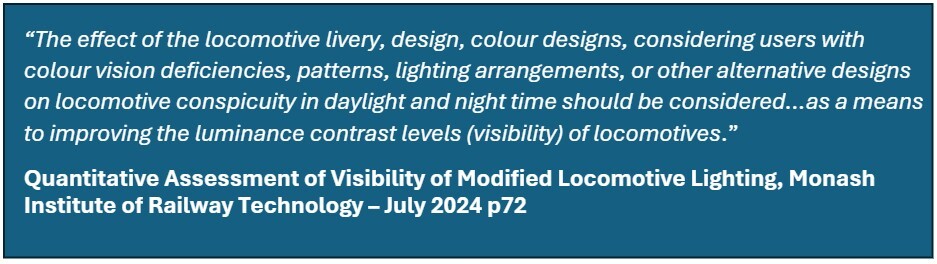
One area covered includes potential controls relating to the nature and cleanliness of locomotive livery. The Monash IRT research found that the nature and cleanliness of locomotive livery’s effects the conspicuity in daylight viewing conditions while locomotive head lights have a greater effect at night. This finding is significant as the ACRI report found that majority of level crossing collisions occur during the day.
Locomotive Livery – Risk Controls for Consideration

While the recommendation above came from the Monash IRT report of 2024, it has its genesis in the work of ACRI/NRTO that ONRSR, the Australasian Railway Association, the Rail Industry Safety and Standards Board and TrackSAFE commissioned two years earlier. The intent of this research was, “to identify potential opportunities that may improve freight vehicle conspicuity and driver awareness when interacting with passive level crossings”.
In all, some 30 potential controls were identified and while most related to a range of lighting and technology advances, the following five controls address the issue of locomotive livery and the opportunities for maintenance and development to play a part in improving locomotive visibility at level crossings.
1. Increased cleaning schedules
- Reduction in visibility/conspicuity controls being dirty and ineffective.
- Improvement to vehicle aesthetics.
- Wear may reduce for certain components due to less time in poor condition.
- Opportunity to utilise sensor technology and adopt reactive cleaning procedures.
- Locomotives that run in trailing or remote positions on a train will often become dirty at a faster rate than the leading locomotive. Where practical operators should wash locomotives when marshalling them into the lead position.
2. Self-cleaning photocatalyst-based agents/coating
- Can be applied directly on the existing paint without changes to the vehicle.
- Luminescence in the paint/coating can allow glowing at night feature.
3. Dirt repellent paint/coating
- Can be applied directly on the existing paint without changes to the vehicle.
- Already in use for some fleets, in particular new passenger fleets.
- Potential low-cost control.
4. Alterations to existing paint schemes
- Potential for better contrast between the locomotive and backgrounds.
- Potential for new colour scheme to raise community awareness of locomotives / level crossing safety.
- Photo reflective or fluorescent paint may improve conspicuity during daylight hours.
5. Attention grabbing textures (livery)
- May improve contrast for a greater range of environmental conditions.
- Opportunity to incorporate reflective materials.
- Can be quickly applied to locomotives via decals.
Final Thought
In highlighting these potential controls, and in its regulatory response to safety risk management at level crossings, ONRSR acknowledges that operators must consider all relevant operational, environmental, engineering, financial and legislative processes, and feasibilities.
Following development of the ONRSR Code of Practice –
Train Visibility at Level Crossings, ONRSR undertook to complement its release with in-field compliance and education activities nationally. These activities, including safety case studies such as this one, are informed by regulatory intelligence, data analysis, and research – including further considerations of the three research pieces referenced here.
ONRSR recognises that safety at level crossings relies on significant coordination and action to manage the risks to safety. So, while this case study focuses on actions that rolling stock operators can take, members of the public, rail transport operators, road transport industries, governments, emergency services and regulators all have a vital role to play.
1* Quantitative Assessment of Visibility of Modified Locomotive Lighting, Monash Institute of Railway Technology – July 2024 p71